In most cases, you do not have to replace your entire NYC sidewalk just because DOT issued a violation. Under Section 19-152 of the NYC Administrative Code, the Department must direct property owners to repair sidewalk flags that contain substantial defects. The numbered flags on your Preliminary Inspection Report show which sections DOT has ordered you to replace. You can choose to replace additional flags, but ask your contractor to price that work separately.
How Does DOT Mark the Flags You Must Replace?
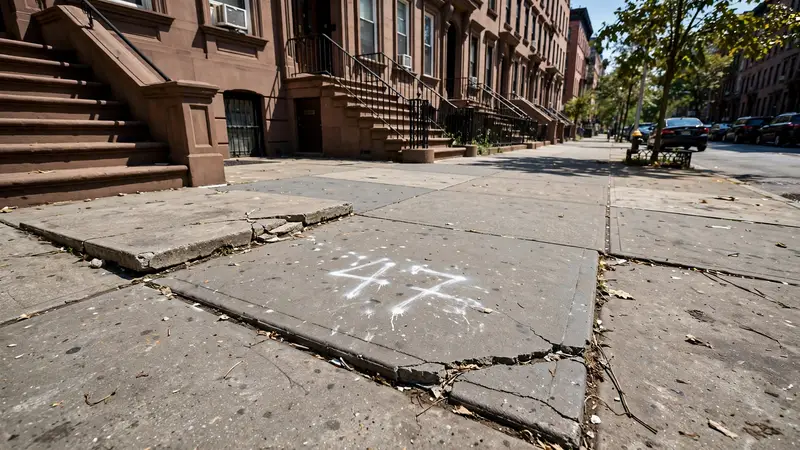
When a DOT inspector finds defects, you get a Notice of Sidewalk Violation with a Preliminary Inspection Report. The report includes a sketch of your frontage, and every flag DOT wants replaced is marked with a number on that sketch. DOT's own rule is plain: every flag marked with a number must be replaced and any defects must be corrected. Read the Notice of Sidewalk Violation and DOT's sidewalk guidance for more information.
The sketch is the order. If a flag has no number on it, DOT did not order it replaced under that notice. Work from the latest sketch, because the newest notice supersedes earlier ones. An old sketch with different markings does not control the job.
What Counts as a Substantial Defect?
Section 19-152 of the Administrative Code says the commissioner shall direct the owner to repair only those sidewalk flags that contain a substantial defect. The code lists nine kinds:
- A flag that is missing, or a sidewalk that was never built.
- A flag cracked so badly that pieces may loosen or come off.
- An undermined flag with a visible void underneath, or a loose flag that rocks or seesaws.
- A trip hazard, where the height difference between neighboring flags is half an inch or more, or a surface defect at least one inch across and half an inch deep.
- Improper slope: a flag that does not drain toward the curb and retains water, flags that must be replaced to provide adequate drainage, or a cross slope that exceeds established standards.
- Hardware defects: hardware or other fixtures that are not flush within half an inch of the sidewalk surface, or cellar doors that deflect more than one inch when walked on, lack skid resistance, or are otherwise dangerous or unsafe.
- A structural-integrity defect, where a flag shares a common joint (not an expansion joint) with a defective flag and has a crack reaching that joint and one other joint.
- Non-compliance with DOT construction specifications.
- Patchwork, such as thin surface patches or asphalt laid over concrete.
The structural-integrity item surprises owners most. A neighboring flag may qualify as defective even if its damage looks minor. However, the statutory conditions must be met: the flags must share a common joint that is not an expansion joint, and the crack must reach that joint and another joint. If you believe DOT applied this rule incorrectly, you can request a reinspection.
Do You Have to Replace the Whole Sidewalk?
No. The code says the owner is only responsible for the cost of repairing the defective sidewalk flags ordered or directed by the department, not an entire sidewalk if the entire sidewalk lacks defects.
If a contractor quotes the entire frontage, ask for an itemized estimate. The quote should distinguish the flags required by the violation from any additional repairs the contractor recommends. Extra work may be reasonable, but you should understand what DOT requires and what you are choosing to add.
Two related limits help. DOT cannot order you to repair a flag damaged by the city, its agents, or a city contractor during a capital construction project. For corner properties, the intersection quadrant counts as part of your frontage under the same rule, so a flagged corner flag is still one flagged flag, not a reason to redo the block.
When Does Replacing Extra Flags Save You Money?
Extra flags are voluntary, and they are your call, not DOT's. Owners most often consider adding them in three situations.
First, a neighboring flag is borderline. A neighboring flag may deteriorate further and require separate repairs later. Completing suitable additional work during the same project may reduce the chance of another repair job, although the decision should depend on the flag's actual condition and the contractor's assessment.
Second, level and finish. New flags poured next to sunken old ones can leave a lip at the joint, and a lip of half an inch is itself a trip hazard. Contractors may suggest replacing the pair so the walk sits even and drains toward the curb.
Third, patchwork. Thin surface patches and asphalt over concrete count as defects on their own, so a cheap patch on a neighboring flag can create the next violation instead of preventing it.
Extras do not change the order. Complete the repairs required by the notice within the applicable deadline. Replacing additional flags does not extend that deadline. Once the required work is complete, request a dismissal inspection through 311. Get extras priced as a separate line on the quote, so you can see what the order costs and what you chose to add. Read more about the 75-day NYC sidewalk deadline.
What If You Disagree With the Flags DOT Marked?
If you disagree with the marked flags, request a reinspection within 75 days of receiving the notice. A different DOT inspector will assess the sidewalk without access to the first inspector's report, and DOT will issue a new notice reflecting the results. If you still believe the decision is incorrect, review the applicable appeal procedures and deadlines or consult a qualified attorney. Do not assume that requesting a reinspection automatically pauses the repair deadline. See the NYC sidewalk violation appeal guide.
Do not simply ignore flagged work while disputing it, since an open violation can cloud title and complicate selling or refinancing.
What to Do When the Sketch Arrives
- Photograph every flag, marked and unmarked, with the sketch beside it for reference. To check the violation record first, use the lookup tool.
- Walk the sketch flag by flag and count exactly what DOT ordered.
- Get quotes that price the ordered flags as one line and any extras as a separate line.
- Check the contractor's license and get the permit before work starts. You will need a licensed contractor, and the permit costs $70 per 300 linear feet.
- After the work, request a dismissal inspection through 311 to close the violation.
Frequently Asked Questions
Do I have to replace every flag on my sidewalk?
No. Only the flags DOT marked on your inspection sketch, because the code limits the order to flags with a substantial defect.
What if a flag next to a marked flag is cracked but not marked?
It is not part of the order under that notice, so replacing it is your choice. A neighboring flag may deteriorate further, which is why owners sometimes choose to replace it during the same project.
Can DOT add more flags later?
Yes. DOT may issue a new notice after another inspection. According to NYC DOT, the newest sidewalk violation notice supersedes earlier notices. Check the new inspection sketch and the deadline stated in the notice rather than assuming the earlier markings or deadline still control.
Does replacing extra flags change my 75-day deadline?
No. The deadline runs from the notice, and extra work neither extends it nor reduces what DOT ordered.
Who pays if DOT does the work?
If you miss the deadline, DOT can do the work and the Department of Finance bills you, with administrative expenses of up to 20 percent on top of the repair cost. Unpaid bills can become a lien on the property.
What if the city damaged the flag?
The code bars DOT from ordering you to repair a flag damaged by the city, its agents, or a city contractor during a capital construction project. Raise that with evidence, such as photos and the project record, through the reinspection route.
The Bottom Line
Use the latest DOT inspection sketch to identify the flags covered by your violation. Ask contractors to separate required repairs from optional work, and confirm the permit requirements and deadline before starting. Once the required repairs are complete, request a dismissal inspection through 311.
Not sure whether a violation has been issued for your property? Use our NYC sidewalk violation lookup tool to check the available violation information.