- What a Notice of Sidewalk Violation actually is
- Why the City issues them at all
- Why your property was inspected
- What arrives with the notice
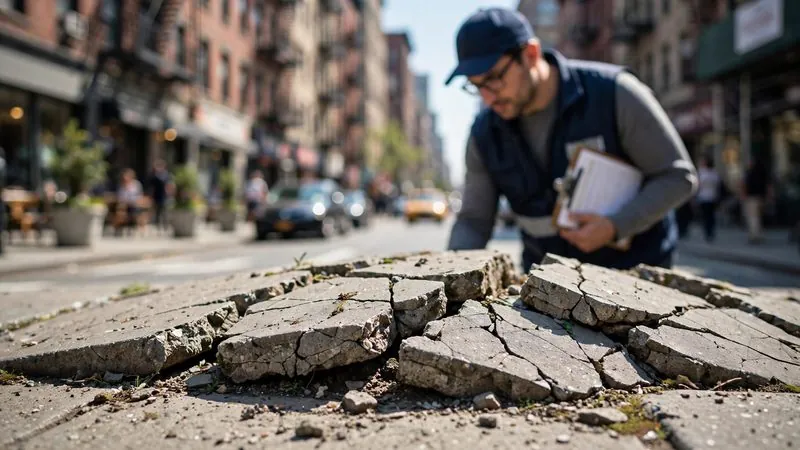
- What counts as a defect
- The 75-day repair period, and how it's counted
- If you've received more than one notice
- Your options after receiving one
- What happens if you do nothing
- The ten-day version
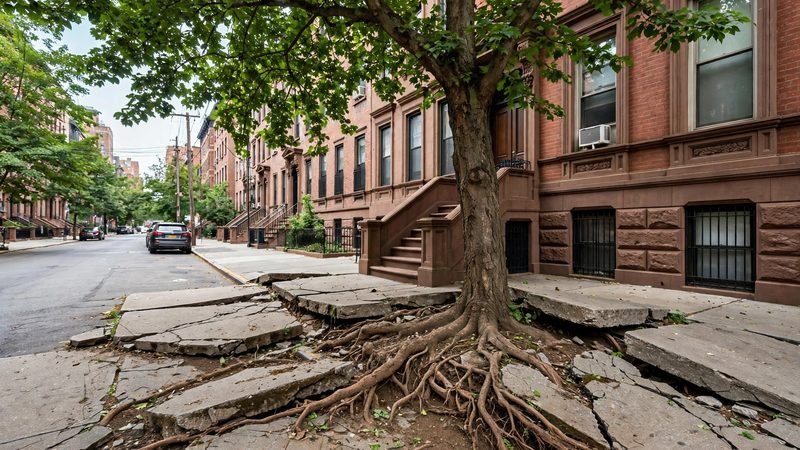
- If the damage was caused by a City tree
- If you think the violation is wrong
- How a violation comes off the record
- How to check whether a property has one
- Verifying any of this yourself
- Frequently asked questions
A sidewalk violation is an official notice from the New York City Department of Transportation stating that the sidewalk in front of a property is defective. There is no fine attached to it. A copy is filed with the County Clerk for the borough where the property sits, and it stays on file until the Clerk receives official notification from the City that satisfactory repairs have been made. The property owner has 75 days from receiving the notice to make the repairs. If they aren't made, DOT may hire a contractor to do the work and the Department of Finance will bill the owner for it.
Those four facts come from NYC DOT's sidewalks page and § 19-152 of the Administrative Code. Everything below expands on them, and every claim links to the source it came from.
To check whether a specific property has a violation, run a free sidewalk violation lookup.
What a Notice of Sidewalk Violation actually is
DOT describes it plainly: a sidewalk violation is an official notice issued to a property owner stating that the sidewalk is defective (NYC DOT). It is an order to do work. It is not a summons, it is not a ticket, and it does not carry a monetary penalty on issuance.
That last point is the single most common misunderstanding about these notices, and it is worth being blunt about, because a lot of what's written online gets it wrong. Contractor and law-firm pages routinely tell readers to act fast "to avoid costly fines." There is no fine to avoid. DOT states directly that there is no fine associated with a violation, and the Street Works Manual says the same thing. What there is instead is a repair obligation, a deadline, and a cost consequence if the deadline passes, which is a different thing, and in some ways a more serious one, because the eventual bill is open-ended in a way a fixed fine is not.
Three things happen when a violation is issued:
- The notice is served on the owner. Under § 19-152(f), service is made on the owner or their designated managing agent, personally or by certified or registered mail with return receipt requested, addressed to whoever appears on the city collector's records as the owner. If the tax bills for the property go to someone other than the owner, the notice goes to that party as well. If the postal service returns the order marked as refused, it may then be served by ordinary mail and posted conspicuously on the premises.
- A copy is filed with the County Clerk. § 19-152(g) requires a copy of the notice or order to be filed in the office of the clerk of each county where the property sits, along with proof of service. This filing is why a violation shows up in a title search, and it's why DOT notes that a violation may complicate selling or refinancing a property.
- The clock starts. The order must specify a reasonable time for compliance, and § 19-152(c) sets a floor: the time for compliance shall be a minimum of 75 days.
On the sale question specifically: several contractor sites state flatly that an open violation will stop you from selling your home. DOT's own language is more careful, a violation may complicate selling or refinancing a property. NYC311 uses similar language, noting that an existing violation or lien may prevent a sale or refinance. In practice the obstacle is usually the title company or the lender rather than the City, and how much friction it creates depends on the transaction. If you're mid-sale, that distinction matters.
Why the City issues them at all
DOT's stated reason is preventive: the City issues sidewalk violations to encourage property owners to repair their sidewalks and enhance public safety. New York has over 12,000 miles of sidewalk, and the City replaces more than two million square feet of it a year, mostly on City-owned property and in residential neighborhoods of predominantly one-, two-, and three-family homes (NYC DOT).
Underneath that sits an allocation of responsibility that predates any individual notice. § 19-152 puts the duty to install, repave, reconstruct, and repair sidewalk flags on the owner of the abutting property, at the owner's own cost, including, for corner properties, the intersection quadrant. Separately, § 7-210 makes owners potentially liable for personal injuries caused by a failure to keep the sidewalk free of defects.
Those are two different exposures. The violation is an administrative order about repair. The liability is a civil exposure to an injured pedestrian. Fixing the sidewalk addresses both, but neither one cancels the other, and closing out a violation does not retroactively erase liability for an injury that already happened.
Why your property was inspected
DOT inspects sidewalks throughout the city, and where inspectors find an unsafe condition, a notice is issued. There is no published list of what puts a specific block on the schedule, and any site that gives you one is guessing.
What the law does say is that inspection is a prerequisite. Under § 19-152(a), the commissioner directs an owner to repair a defective flag after an inspection of the property by a departmental inspector. A violation cannot be generated from a complaint alone.
There is also a second track worth knowing about, because almost nothing written for property owners mentions it. § 19-152(a-1) describes a prior notification program, the route by which DOT is told about a defective flag by a member of the public or by a DOT employee. For defects identified this way, the statute adds a threshold: the sidewalk must be deemed to be a hazard before a violation issues for any of the substantial defects listed in the code. And "hazard" is defined more narrowly than "substantial defect." It covers:
- a missing flag, or sidewalk that was never built;
- a flag cracked badly enough that pieces may be loosened or readily removed;
- an undermined flag with a visible void beneath it;
- a loose flag that rocks or seesaws;
- a vertical difference between adjacent flags of half an inch or more, or a surface defect an inch or more across in all horizontal directions and half an inch or more deep;
- cellar doors that deflect more than an inch when walked on, aren't skid resistant, or are otherwise dangerous.
Improper slope, patchwork, hardware that isn't flush, and non-compliance with DOT specifications appear in the substantial-defect list but not in the hazard list. If your violation came out of a complaint rather than a routine sweep and cites only those conditions, that gap is worth raising when you request a re-inspection.
One more carve-out, in the same subdivision: the commissioner shall not direct an owner to repair a sidewalk flag that was damaged by the City, its agents, or any contractor employed by the City during a city capital construction project. If your sidewalk was torn up during City work and a violation followed, that sentence is the one to point at. (Damage by a utility company or a private contractor is handled differently, DOT directs owners to document it and pursue the responsible company, and you can search DOT-issued permits for an address at nycstreets.net to identify who was working there.)
What arrives with the notice
The envelope contains more than a letter. § 19-152(c) requires the order to give a detailed explanation of the inspection and the defects, organized by sidewalk flag, together with a detailed diagram of the property showing the defects by type. That diagram is the Preliminary Inspection Report, usually called the PIR.
The PIR is the operative document. DOT's rule is unambiguous: every flag marked with a number on the PIR must be replaced and any defects corrected. Flags marked with an "X" may be replaced by DOT at no charge to the owner, with the final decision made by a Department of Design and Construction engineer at the time of construction.
The PIR also carries the estimated square footage that drives the City's cost estimate, and § 19-152(c) requires the order itself to include an estimate of the cost of the repair work. DOT explains the arithmetic: multiply the estimated square footage on the PIR by the cost per square foot shown on the letter that came with the notice, using the seven-inch concrete cost for any driveway area and the four-inch cost for everything else. That gives you a rough figure for what the City would charge if it ends up doing the work.
The order must also tell you about the DOT borough offices, the complaint and appeal process, your right to request a re-inspection, and how to file a notice of claim with the Comptroller afterward.
Read the PIR against your actual property before you do anything else. DOT specifically suggests checking the width and other dimensions and the location of trees, signs, utility caps, cellar doors, and similar features. A PIR that describes a property that isn't yours is the clearest possible basis for a re-inspection request.
What counts as a defect
This is the part almost nobody reproduces accurately. The defects that can be cited are listed in § 19-152(a), and they come with measurements.
| # | Defect | What the code says |
|---|---|---|
| 1 | Missing flag | One or more flags missing, or the sidewalk was never built |
| 2 | Cracked flag | Cracked to such an extent that one or more pieces may be loosened or readily removed |
| 3 | Undermined or loose flag | A visible void beneath the flag, or a flag that rocks or seesaws |
| 4 | Trip hazard | Vertical grade difference between adjacent flags of ½ inch or more; or a surface defect 1 inch or greater in all horizontal directions and ½ inch or more deep |
| 5 | Improper slope | A flag that doesn't drain toward the curb and retains water; flags that must be replaced for adequate drainage; or a cross slope exceeding established standards |
| 6 | Hardware defect | Hardware or appurtenances not flush within ½ inch of the surface; or cellar doors that deflect more than 1 inch when walked on, aren't skid resistant, or are otherwise unsafe |
| 7 | Structural integrity | A flag sharing a common non-expansion joint with a defective flag, where a crack meets that common joint and one other joint |
| 8 | Non-compliance | Doesn't meet DOT specifications for sidewalk construction |
| 9 | Patchwork | Less-than-full-depth repairs to broken, cracked, or chipped flags; or flags built partly or wholly with asphalt or other unapproved non-concrete material |
Source: § 19-152(a), NYC Administrative Code. Patchwork caused by installing canopy poles, meters, light poles, signs, and bus stop shelters is excepted unless it independently amounts to one of defects 1 through 8.
Item 9 deserves a warning. A fair amount of published advice suggests skimming a thin layer of concrete over minor cracks as maintenance. Under the code that is patchwork, and patchwork is itself a citable defect. A cosmetic surface repair can convert a flag that might have passed into one that won't. If a flag needs work, it needs full-depth replacement to DOT specification.
NYC311 adds a scale check that's useful for judging your own sidewalk before an inspector does: holes as small as an inch across, and flags raised as little as half an inch, are enough to cause injuries.
The 75-day repair period, and how it's counted
DOT: a property owner has 75 days to make a repair after a Notice of Sidewalk Violation has been received. § 19-152(c) sets that as a statutory minimum for the compliance period.
The counting rules matter more than the number:
- The clock starts on receipt, not on issuance. The 75 days begins when the notice is received by the property owner as indicated on the certified mail receipt.
- If it couldn't be delivered, posting starts it. When the notice isn't delivered by mail, it's posted on the property, and the posting date is the start of the 75 days. NYC311 states the same rule.
- Winter does not extend it. The 75-day period is the same throughout the year. DOT's guidance is to schedule a contractor to perform the repairs as weather permits. NYC311 separately acknowledges that cold weather will most likely prevent work from being done and that DOT's own contractors won't work until weather permits, but neither source describes any extension of the owner's 75 days.
- A permit does not extend it. DOT states this explicitly: a sidewalk permit does not extend the 75-day period to start repairs.
There is one provision that softens the deadline slightly, and it's in the statute rather than on any agency web page. Under § 19-152(e), an owner is deemed to have complied if they obtain a permit from the department to perform the work specified in the order within the time set forth in the order, and complete the work within ten days after that. In other words, permit inside the window plus completion within ten days of the permit is treated as compliance. Do not lean on this without confirming how DOT applies it in your case, call 311 and ask, in writing where you can.
If you've received more than one notice
DOT's rule: if a property owner has received multiple Notices of Sidewalk Violation, the newest violation supersedes all previous notices. Work from the most recent PIR. An older notice sitting in a drawer describing different flags is not a second obligation running in parallel.
If a lookup returns more than one record for your address, superseded prior notices are the ordinary explanation, but the display can be ambiguous, and the public dataset is not the County Clerk's legal record. Before a closing or a refinance, request the status directly from DOT through 311.
Your options after receiving one
There are four, and they aren't equally good.
- Repair it privately. The default path, and the one that keeps you in control of cost and timing. Hire a contractor familiar with DOT specifications; NYC311 notes that any contractor doing sidewalk repair costing more than $200 must hold a Home Improvement Contractor license from the Department of Consumer and Worker Protection, and you can verify a license through DCWP. The contractor obtains the sidewalk construction permit through nycstreets.net. A homeowner doing the work themselves may apply for a permit by mail. The permit fee is $70 for every 300 linear feet of sidewalk for any one property, and multiple permits may be needed for a corner property or a through lot.
- Request a re-inspection. Available if the defects on the PIR don't match your sidewalk, within 75 days of receiving the notice. Covered below.
- Do nothing and let the City do the work. A real option with real consequences, covered in the next section. It is not free, and the cost is not yours to control.
- Check whether it's a City tree. If the damage is caused solely by a City tree, the analysis changes entirely for one-, two-, and three-family properties. Also covered below.
What is not an option: asking the City to come fix it for you. NYC311 states it directly, the City does not accept requests to repair your sidewalk.
If you'd rather have the whole process handled for you, our NYC sidewalk violation removal service takes it from inspection through dismissal.
What happens if you do nothing
The chain is long and it runs through four agencies. Assembled from DOT and § 19-152:
- DOT does the work. If defects aren't repaired within 75 days, DOT may perform the repair or hire a contractor to do it. DOT's current guidance says the property owner will receive a formal notification before the City's contractor arrives, and that a consultant or City representative will photograph the sidewalk to document the pre-construction condition and mark the flags to be replaced.
- Finance bills you. After the defects are repaired, the owner receives a bill from the Department of Finance and DOT notifies the County Clerk's office to remove the violation from its records. Under § 19-152(e), the recoverable debt is the cost of the work plus administrative expenses, capped at 20 percent of the cost of performance.
- You pay only for what was ordered. § 19-152(i): the owner is responsible only for the cost of the defective flags the department ordered repaired, not an entire sidewalk, if the entire sidewalk lacks defects. Worth knowing before you read a bill that looks larger than the PIR suggested.
- Ninety days, then interest. DOT states the owner has 90 days to pay before interest is added, after which interest accrues and a monetary lien is placed against the property. § 19-152(j) puts the same 90 days on the statutory footing, running from the date of entry of the charge.
- The lien is unusually senior. § 19-152(e): the debt becomes a lien prior to all liens or encumbrances on the property, other than taxes. It's collected and foreclosed the same way as tax liens.
- A payment plan exists, and it has criteria. DOT points owners to a Department of Finance Business Center or 311's sidewalk repair payment plan page. The statutory version, in § 19-152(m): on written application by the owner of a one-through-six-family house, or an owner of property assessed at no more than $30,000, where a charge over $250 but not over $5,000 has been entered, the Finance commissioner may divide the charge into four roughly equal annual installments. Miss an installment by 30 days and the commissioner may void the agreement and accelerate the balance. The City may not enforce the lien against an owner who is current on such an agreement.
- The work carries a guarantee. DOT states the contractor's work is guaranteed for 18 months from the end of the contract period.
- Disputes follow a fixed order. If you object to the quality of the work, the amount done, or the measurements behind the bill, DOT sets out three steps that must be followed in exactly this sequence: appeal in writing to a DDC borough office, phone calls and personal visits are not considered appeals; then, if unsatisfied, file a Notice of Claim with the Comptroller; then, if the Comptroller doesn't find in your favor, file a Petition of Appeal at the New York State Supreme Court, Small Claims Assessment Review Part. Petition forms are provided at no cost by the County Clerk's office, and eligibility requires alleging that at least 30 days have passed since the Notice of Claim was presented without a determination, or that it was denied.
The ten-day version
One provision that surfaces in garbled form on contractor sites and is usually dismissed as a myth. It isn't a myth, but it's narrow.
§ 19-152(d): where DOT has been notified in writing of a defective, unsafe, dangerous, or obstructed sidewalk condition under § 7-201(c), and the department determines the condition constitutes an immediate danger to the public, it may notify the owner and direct repair within ten days of service. § 19-152(e) then attaches the same do-it-and-bill-you consequence to that shortened period.
So: 75 days is the ordinary rule and the statutory minimum for a standard order. Ten days applies only in the immediate-danger scenario described above. If your notice specifies ten days rather than 75, that is why, and it is not an error.
If the damage was caused by a City tree
For many outer-borough homeowners this is the most important section on the page, and it's the one where published advice is furthest out of date.
DOT states two things plainly. The City will no longer issue a sidewalk violation for one-, two-, and three-family properties that have sidewalk damage caused solely by City trees. And: DOT has completed its review of all outstanding Notices of Sidewalk Violation for one-, two-, and three-family properties, determined which were caused solely by City street trees, and will cancel the lien for any that meet the criteria.
DOT adds that NYC does not charge owners of one-, two-, and three-family properties for the repair of a sidewalk damaged by a City tree or tree roots. NYC311 states the same rule, and states the boundary: sidewalk defects caused by trees or tree roots next to properties with four or more units, commercial buildings, or vacant lots remain the property owner's responsibility.
Two qualifications, both load-bearing:
- "Solely" is doing real work. A sidewalk with root lift and an unrelated patchwork repair is not damage caused solely by a City tree.
- Repair eligibility is separate from violation relief. NYC Parks runs the Trees & Sidewalks Program, which can repair severe City-tree root damage in front of one-, two-, and three-family homes that are not used commercially and are owner-occupied, legally, NYC Tax Class 1. Funding is limited and repairs are prioritized by severity, scored on pedestrian usage, passable width, vertical lift, number of damaged flags, and the condition of the tree. Parks is explicit that where you already hold a DOT Notice of Violation, the repair needed to lift that notice may be beyond the scope of the program, since the program addresses only City-tree root damage. Parks also offers a free Root and Sidewalk Consultation if you intend to hire your own contractor.
And a hard rule regardless of any of the above: cutting or shaving the roots of City-owned trees is strictly prohibited.
If you think the violation is wrong
The defects don't match your sidewalk. You may request a re-inspection within 75 days of receiving the notice, by contacting 311. What follows, per DOT and § 19-152(c):
- DOT reviews the request and schedules a re-inspection within 180 days.
- A different inspector performs it, without access to the first inspector's report, the statute requires an independent inspection.
- You'll be notified by mail at least five days before the date.
- Inspectors will not come to the door; they're prohibited from seeking out owners during re-inspections.
- The inspector files a new report and DOT issues a new order with the results and a new diagram. This is the final inspection.
Have the violation number ready. NYC311 notes sidewalk violation numbers are 4 to 6 digits.
It was issued to the wrong owner. NYC311 attributes this to DOT relying on outdated ownership records. Ownership corrections go by mail to the Department of Finance, Correspondence Unit, 66 John Street, 3rd Floor, New York, NY 10038, and the appeal itself still goes through 311.
How a violation comes off the record
The record does not clear because the concrete is new. It clears because an inspector confirms it.
If you did the repair: once work is complete, contact 311 to request a Sidewalk Violation Dismissal Inspection. Have ready: permit number, property address, block and lot, violation number, and the owner's email and phone. NYC311 notes that permit numbers begin with a letter referencing the borough followed by 12 or more characters. Make sure the entire sidewalk is visible before the inspection. DOT sends an inspector to verify the work was satisfactorily completed, and the violation is removed once that's confirmed. NYC311 conditions this on the repairs having been completed by a licensed contractor with a valid sidewalk construction permit, which is a strong argument against unpermitted work, however small.
If the City did the repair: DOT notifies the County Clerk's office to remove the violation. If it hasn't come off, you can still submit a removal request through 311 with the violation number.
Removing a County Clerk lien: NYC311 notes a dismissal inspection may be required before a lien can be removed.
How to check whether a property has one
There is no public address-search tool on DOT's website, despite what several ranking articles say. We've checked; if DOT adds one, this page will say so.
What exists:
- Our lookup, which reads NYC's published sidewalk datasets. Free, no account, and not an official record, run a lookup.
- NYC311, which is the authoritative route: request the status or a copy of a sidewalk violation. This is a request you submit, not a self-serve search, and DOT responds.
- NYC Open Data, for the underlying datasets, see how our lookup works.
- The County Clerk, which holds the filed copy under § 19-152(g), the record that matters in a title search.
Before a closing, treat any tool's output as a starting point and confirm through 311 or the Clerk.
Verifying any of this yourself
Everything above is linked to its source. Start here:
- NYC DOT — Sidewalks
- NYC311 — Sidewalk Violation and Repair
- § 19-152 — owner duties and the defect list
- § 7-210 — sidewalk liability
- NYC Parks — Trees & Sidewalks Program
- DCWP — check a contractor's license
Found something on this page that's out of date or wrong? Tell us, we'll check it against the source and correct it.
Frequently asked questions
Is a sidewalk violation a fine?
No. NYC DOT states there is no fine associated with a violation. It's an order to repair. The cost exposure comes later: if repairs aren't made within 75 days, DOT may do the work and the Department of Finance will bill you.
How long do I have to fix it?
75 days from when you receive the notice. § 19-152(c) sets 75 days as the statutory minimum compliance period. The clock starts on the certified mail receipt date, or on the posting date if the notice couldn't be delivered.
Will the City fix my sidewalk if I ask?
No. NYC311 states the City does not accept requests to repair your sidewalk. The City performs the work only after a violation goes unaddressed for 75 days, and then bills you. The exception is the NYC Parks Trees & Sidewalks Program for City-tree root damage at eligible one-, two-, and three-family homes.
Does a sidewalk violation affect selling my home?
It can. DOT says a violation may complicate selling or refinancing, and NYC311 notes an existing violation or lien may prevent a sale or refinance. The filed County Clerk copy is what surfaces in a title search. It is not an outright legal bar to selling, contrary to what several contractor sites say.
What if I got the violation in winter?
The 75-day period is the same throughout the year. DOT's guidance is to schedule a contractor to work as weather permits. NYC311 acknowledges cold weather will likely prevent work and that DOT contractors won't proceed until weather permits, but no source describes an extension of the owner's 75 days.
Does taking out a permit give me more time?
tain the permit within the time set in the order and complete the work within ten days after. Confirm with DOT through 311 before relying on it.
I have an old violation and a new one. Which applies?
The newest. DOT states the newest violation supersedes all previous notices. Work from the most recent PIR.
My notice says ten days, not 75. Is that a mistake?
Probably not. Under § 19-152(d), where DOT has been notified in writing of a condition it determines to be an immediate danger to the public, it may direct repair within ten days of service.
Who pays if a City tree caused the damage?
For one-, two-, and three-family properties with damage caused solely by City trees, DOT states it will no longer issue a violation, and that it has completed a review of outstanding notices and will cancel qualifying liens. Properties with four or more units, commercial buildings, and vacant lots remain the owner's responsibility per NYC311.