- How do I verify a contractor is licensed in NYC?
- What permits does sidewalk work require?
- What should a sidewalk quote itemize?
- Should neighbors hire one contractor for the whole block?
- What finish should the concrete have, and how long does it cure?
- What are the red flags in a contractor pitch?
- Can I repair the sidewalk myself?
- Frequently Asked Questions
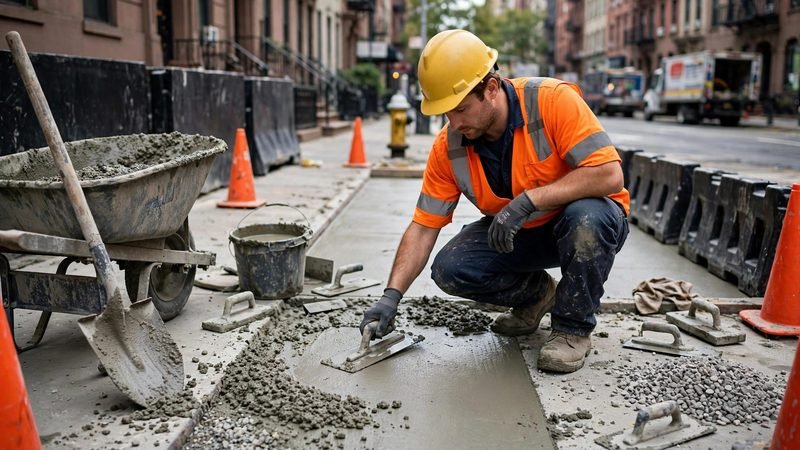
Start with NYC DOT's official sidewalk page and DCWP's licensed-contractor database: hire a DCWP-licensed contractor who knows NYC DOT specs, make sure they pull the $70 sidewalk construction permit, compare two or three itemized quotes, and confirm everything in a written contract before the 75-day repair deadline runs out.
A violation notice gives you a firm deadline, and the contractor you hire determines whether the repair clears it on the first try. Here is how to check a contractor out, what the permits cost, what belongs in a quote, and which red flags should send you looking elsewhere.
How do I verify a contractor is licensed in NYC?
New York City requires any person or business doing home improvement work that costs more than $200 on a residential building to hold a Home Improvement Contractor license from the Department of Consumer and Worker Protection (DCWP). Sidewalk repairs fall under that rule, and DCWP's hiring tips page lists checking license status as the first step.
Do these three checks before you sign anything:
1. Look the contractor up. Ask for the license number, then verify it through 311 or at nyc.gov/dcwp. DOT's own sidewalk page recommends using DCWP's database of licensed contractors, and notes that the database also shows the number and type of complaints filed against the contractor.
2. Check the complaint history. Call 311 and say "Business Background Check" to pull the contractor's record with DCWP, and ask nearby neighbors if they have used the company before. DCWP maintains a Home Improvement Contractor Trust Fund that may reimburse you if a licensed contractor does not finish the job or owes you money, but you are not eligible if you hired an unlicensed contractor.
3. Confirm DOT familiarity. DOT's guidance is to hire a contractor who is familiar with NYC DOT specifications for sidewalk repair. Ask directly how many violation clearances the contractor has handled in your borough, and whether they will file for the sidewalk construction permit themselves. If you hire a contractor, DOT's procedure says the contractor must be the one to apply for the permit through nycstreets.net.
What permits does sidewalk work require?
A sidewalk construction permit is required before repairs begin. The current fee is $70 for every 300 linear feet of sidewalk for any one property, and multiple permits may be needed for a corner property or a through lot. A permit does not extend the 75-day repair period, so factor the application into your schedule.
Two exceptions and details worth knowing:
- Small non-violation repairs. Under Title 34 of the Highway Rules, a permit is required where the work covers more than 25 square feet. Work of 25 square feet or less needs a permit only when its purpose is to remove a violation. If you already have a notice, assume you need one.
- Who applies. Contractors apply through nycstreets.net. Private homeowners doing their own repairs can apply by mail, but only with a notarized Affidavit of Ownership, a stamped self-addressed envelope, and a certified check payable to NYC DOT sent to 55 Water Street, Concourse Level. A contractor who asks you to pull the permit for them is working outside DOT's stated process.
- What the fee covers. The $70 covers the administrative cost and the inspector's visit for the dismissal inspection after the work is done. Corner properties need two permits if work happens on both sides.
Before you sign a contract, your contractor must give you written notice about every permit the job requires: the type of permit, who will obtain it, the steps involved, the estimated fees, and how you can verify the permit's status. That disclosure is required by DCWP, so treat its absence as a warning sign.
What should a sidewalk quote itemize?
Get written estimates from more than one licensed contractor. Contractors must give you a written estimate if you request one (they may charge a reasonable fee, but they must tell you the cost up front), and DCWP publishes a sample estimate you can use to compare bids side by side.
A usable quote should spell out each of these:
- Scope of work. Which slabs are being replaced, down to the flags marked on your Preliminary Inspection Report. DOT requires every numbered flag on the inspection sketch to be replaced, so a quote that only addresses part of the flagged area will not clear the violation.
- Materials and specs. Concrete strength, slab thickness, and joint layout. This is what the dismissal inspector checks against DOT standards.
- Demolition and haul-away. Breaking up and removing the old concrete is real labor and disposal cost, and cheap quotes often bury it or leave it out entirely.
- Permit fees. The $70 permit (or $140 for a two-frontage corner) should appear as its own line item, not hidden inside a lump sum.
- Timeline. Start date, estimated completion date, and how long the concrete needs before you can use it (more on curing below).
- Payment schedule and warranty. DCWP requires the contract to include important dates, a description of the work and materials, the payment schedule, and all charges, guarantees, and warranties. You must receive a copy of the signed contract before work begins.
For a sense of how these line items typically run, read our breakdown of sidewalk repair costs in NYC before you start collecting bids.
Should neighbors hire one contractor for the whole block?
This idea comes up regularly in owner forums: if several houses on a block all need work, why not bring in one contractor for the full run? It can work, and it has real upsides. One mobilization for several addresses can bring the per-property price down, the concrete finish stays consistent across the block, and the contractor has a simpler relationship with DOT's permit office when the jobs are adjacent.
It also has real complications worth sorting out before anyone signs:
- Coordination. Someone has to collect payments, agree on scope, and decide what happens if one neighbor backs out mid-job. Without a written agreement between the owners, that coordinator carries all the friction.
- Permits are per property. Each address still needs its own sidewalk construction permit at $70, and each violation has its own clock. The contractor files each one, but the 75-day deadline is yours, not the block's, so a neighbor's delay cannot pause yours.
- Liability lines. Each owner's contract should be separate, even if the contractor is shared. If work on your neighbor's frontage fails inspection, you do not want your dismissal tied up in it.
- One bad hire, multiplied. A shared contractor who cuts corners or stalls leaves the whole block exposed. Verify the license and complaint history exactly as you would for a solo hire.
The block approach works best when one organized neighbor handles logistics, every owner has their own written contract, and everyone verifies the contractor independently first.
What finish should the concrete have, and how long does it cure?
Ask for a broom finish. It is the light, textured surface you see on most city sidewalks: the contractor drags a special broom across the concrete before it sets, leaving fine parallel lines that give shoes grip in rain and snow. Smooth troweled finishes look neat but get slippery when wet, and they are not what DOT expects on a public walkway.
Curing is a chemical process, not just drying, and the clock matters because your dismissal inspection needs a sound slab. Per the Concrete Network's curing guide:
- Wait at least 24 hours before walking on new concrete. The surface may look dry at 12 hours, but it is still wet underneath, and foot traffic leaves permanent marks.
- Give it a full 48 hours before heavier foot traffic, strollers, bikes, or delivery carts.
- Wait a week or longer before vehicles or heavy equipment roll over it.
- Full curing takes about 28 days. Concrete cures best between 50 and 80 degrees Fahrenheit, and cold weather stretches the timeline noticeably.
Make sure your contract states who is responsible for keeping people off the fresh concrete. If a neighbor's delivery driver ruins a two-day-old pour, you want it in writing whose problem that is.
What are the red flags in a contractor pitch?
DCWP's consumer tips double as a scam checklist. Walk away from any contractor who:
- Cannot produce a license number or pressures you to skip the DCWP check. Remember that the Trust Fund repayment option does not exist for unlicensed work.
- Asks for cash or a large upfront payment. Never pay in cash, and pay no more than 25% of the total contract amount up front to get the work started. Keep a record of every payment.
- Refuses a written contract or starts work before you have a signed copy. The contract must include the work description, materials, dates, payment schedule, and warranties, plus a separate Notice of Cancellation form.
- Will not give the permit disclosure. Before entering the contract, the contractor must tell you in writing what permits the job needs, who pulls them, and what they cost. "Don't worry about the permit" is not an answer.
- Offers to arrange financing. Home improvement contractors are not allowed to arrange or offer financing for a home improvement loan. Use your own bank or credit union.
- Quotes far below everyone else. A quote that is much cheaper than two others almost always excludes something: the permit fee, demolition and haul-away, proper slab depth, or coordination with the dismissal inspection. That missing work gets redone at your expense later, and the 75-day repair clock does not stop while you sort it out.
One more honest note about price: if DOT ends up doing the work after your deadline passes, the city hires its own contractor and bills you through the Department of Finance, which is generally the most expensive way to get the job done. The cheapest private quote that fails inspection can lead you straight to that outcome.
Can I repair the sidewalk myself?
The mail-in permit process exists for private homeowners doing their own repairs, and tiny non-violation repairs of 25 square feet or less do not always require a permit. But there is a meaningful gap between what is allowed and what is wise.
A dismissal inspection is a pass-or-fail event against DOT specifications: slab thickness, slope, finish, and full replacement of every flagged section. If the work fails, you redo it, and the 75-day deadline keeps running. A licensed contractor who does this weekly knows the specs, files the permit, coordinates the inspection, and carries the responsibility if the work does not pass. For most owners with an active violation, that is worth paying for.
If the damage comes from a city tree, there may be a different path entirely, so check who pays for NYC sidewalk repairs before spending anything.
Frequently Asked Questions
Does getting a sidewalk permit extend my 75-day deadline?
No. DOT states plainly that a sidewalk permit does not extend the 75-day period. Start your contractor search the day the notice arrives, not the day you have quotes in hand.
Do corner properties need two permits?
If repair work happens on both frontages, yes. The permit fee is $70 per 300 linear feet for any one property, and a corner lot with work on both sides needs a separate permit for each side.
Can I appeal the violation while I hire a contractor?
Yes. You have 75 days from receiving the notice to submit an appeal, and DOT will schedule a reinspection by a different inspector within 180 days. The second inspection's result is final. The NYC 311 sidewalk violation page has the current process and the violation-number format to include with your request.
How do I check a contractor's complaint history?
Call 311 and say "Business Background Check." DOT's licensed-contractor database also shows the number and type of complaints filed with DCWP, so use both before signing.
How long before I can walk on the new sidewalk?
At least 24 hours for light foot traffic, 48 hours before heavier use, and about a week before vehicles. Full curing takes roughly 28 days, and cold weather slows it down.
What happens after the repair is finished?
Contact 311 to request a Sidewalk Violation Dismissal Inspection. Have your permit number, property address, block and lot number, violation number, and contact details ready. Here is what a DOT dismissal inspection involves so you know what the inspector looks for.
Will the city really do the work if I miss the deadline?
Yes. If repairs are not made within 75 days, DOT may have a contractor perform the work and the Department of Finance will bill you. After 90 days unpaid, interest accrues and a lien goes on the property. See our NYC sidewalk violations overview for the full sequence.
If you have a notice in hand, the fastest useful first step is confirming exactly what DOT flagged on your property. Run a free address lookup to pull your property's violation and inspection records, then hand those records to every contractor you ask for a quote.