- What a sidewalk lien actually is (and why you can't just pay it away)
- The interest clock you don't want running
- The three-step process, and where the timeline actually breaks down
- What actually happens: real homeowner timelines
- What does "sidewalk lien release" actually mean?
- The escrow question: can you just close anyway?
- If you're on a closing deadline right now
- The bottom line
If a title search just turned up a sidewalk lien and you're staring down a closing date, you're not alone, and you're right to be worried. A sidewalk lien is one of the few violations that can't be paid off like a normal debt. It has to be physically repaired, reinspected by the city, and formally cleared, and none of those steps come with a guaranteed timeline. Here's what the law actually says, what NYC's own agencies say about the process, and what real homeowners have experienced when they tried to clear a lien fast enough to save a sale.
What a sidewalk lien actually is (and why you can't just pay it away)
A sidewalk lien starts as a Notice of Violation, not a bill. Under NYC Administrative Code Section 19-152, property owners are responsible for installing, repairing, and maintaining the sidewalk next to their property, and Section 7-210 makes them liable if someone gets hurt because they didn't. These two sections are the legal backbone of every sidewalk rule the city enforces. See our guide on who is responsible for NYC sidewalk repairs for how these duties apply in practice.
When DOT inspects a sidewalk and finds a defect, cracks, uneven flags, improper slope, a protruding utility cover, it issues a Notice of Sidewalk Violation. The property owner then has 75 days to complete the repair before DOT can step in, hire its own contractor, and bill the owner under Section 19-152.
If the owner doesn't pay that bill within the window DOF gives them, that's when it becomes a lien. Owners typically have 90 days to pay once billed, and after that the city starts charging interest and files the debt as a lien against the property. That filing goes to the county clerk's office and stays on record until the violation is officially dismissed.
This is why "just pay it off" doesn't work the way it does with a mortgage lien. The lien isn't really the debt, it's proof the sidewalk still fails city standards. You have to fix the sidewalk and get DOT to confirm it before the underlying violation and the lien attached to it can be released.
The interest clock you don't want running
Once a lien is in place, interest accrues. Properties assessed over $250,000, plus all vacant land, accrue interest at 18% annually, while smaller properties are charged 8.5% per year under the Administrative Code.
And there's a bigger risk than interest if this drags on for years instead of weeks: the city's annual lien sale. The Department of Finance sells liens on properties with more than $1,000 in overdue charges (or $5,000 for one-to-three family homes) to the NYCTL trust, which then charges 18% interest of its own, and owners get 90 days' notice before their debt is sold. That's not your situation if you're mid-sale with a fresh violation, but it's worth knowing why "I'll deal with it eventually" is a bad plan for anyone reading this later.
The three-step process, and where the timeline actually breaks down
- Repair. Hire a licensed contractor to pull a Sidewalk Construction Permit and complete the work to DOT standards. The permit currently costs $70 per 300 linear feet of sidewalk, and that fee covers the eventual dismissal inspection.
- Reinspection. Request a DOT reinspection through 311 once the work is done (or, per real homeowner experience below, just before). Learn how NYC sidewalk inspections work for what the inspection itself involves.
- Lien release. Once DOT confirms the repair passed, DOF is notified and the lien is released from the county clerk's record.
Here's the problem: none of the official city pages commit to a timeframe for steps 2 or 3. That's exactly the gap homeowners run into when they're on a closing deadline, and it's also exactly what real people have reported when they went through it.
What actually happens: real homeowner timelines
Official rules tell you what has to happen.
Homeowner experiences can give you a sense of what the process sometimes looks like in practice, but they should be treated as anecdotal rather than guaranteed DOT policy.
One homeowner dealing with a sidewalk issue discovered during a property sale reported going through the process twice and getting inspection-related results in roughly a couple of weeks.
A few things stood out from that experience.
File the 311 reinspection request online, not by phone. The homeowner found the phone reps unhelpful, while the online Service Request ("Remove Violation after Repair" under Sidewalk Violation and Repair) created a trackable record with an SR number.
Attach documentation that supports urgency. Including the Sidewalk Construction Permit number, a copy of the signed real estate contract, and photos of the completed repair all helped move the request along. The city's own default language warns of a 30-day response window, but that's described as a worst-case estimate, not a typical one.
Call the DOT Borough Commissioner's Office directly. This was the single most effective step reported. Unlike general 311 phone staff, the Borough Commissioner's Office could take the SR number and, when a documented sale timeline was provided, flag the inspection for priority.
Actual results: roughly two weeks from request to inspection results, both times. Homeowner-filed requests were reported to get priority over contractor-filed ones. DOT emailed a PDF of the inspection results within about a week of the inspection itself, and the lien was released a few days after that. Total time from filing the reinspection request to lien clearance: roughly two to three weeks in this case, though the timeline reportedly isn't published or guaranteed anywhere in the process.
Other homeowners in the same discussion reported similar ranges, inspections in "a few weeks, not months," though this isn't a fixed rule. One key confirmation across multiple accounts: the SR sometimes shows as "closed" before the inspection has even happened, which understandably worries people, but reportedly signals the case has moved into the inspection queue rather than that nothing is happening.
But this is where it's important not to turn individual experiences into a universal timeline.
A homeowner getting a result in two weeks doesn't mean DOT guarantees a two-week sidewalk lien release. Your borough, type of violation, repair details, inspection workload, property circumstances, and whether there is a separate monetary charge can all affect what happens next.
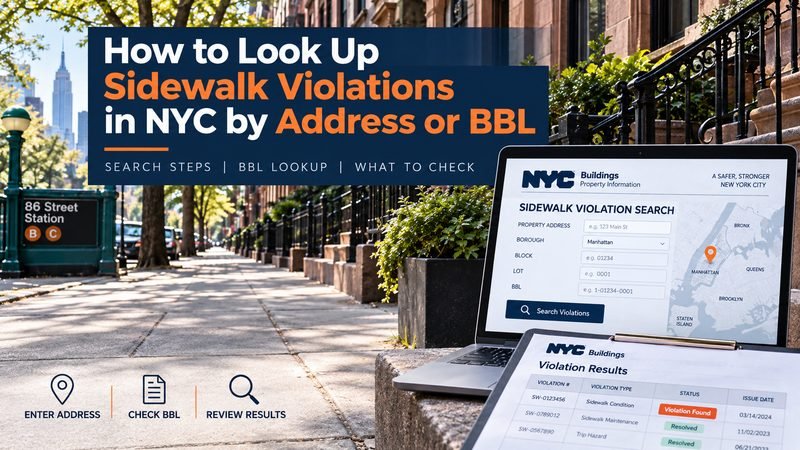
If you want to check where your property actually stands right now rather than guessing, running the property's address or BIN through nycsidewalkviolationlookup.com pulls directly from the city's Sidewalk Management Database and updates daily, which is often faster than waiting on a 311 callback.
What does "sidewalk lien release" actually mean?
This phrase can refer to two slightly different outcomes.
For a privately repaired sidewalk violation, you're usually trying to get the County Clerk sidewalk violation record dismissed after DOT approves the repair.
For City-performed work, you may also be dealing with a monetary sidewalk repair lien associated with the City's repair bill.
That's why searching for "NYC sidewalk lien release" can produce confusing answers.
- One homeowner may need a DOT dismissal inspection.
- Another may need to deal with a Department of Finance bill.
- A third may need both issues confirmed before a title company considers the property clear.
Before doing anything else, find out which one appears in your title search.
The escrow question: can you just close anyway?
This comes up in almost every version of this conversation, and the honest answer is: it depends entirely on your lender, not on you or your attorney.
Some sellers have successfully closed with the lien amount held in escrow, sometimes with a year given to clear it, or with the repair cost simply deducted from the sale price. That works when the buyer is paying cash or their lender doesn't require clear title as a hard condition.
But when a buyer's mortgage lender makes lien clearance a precondition of closing, which is common, escrow isn't on the table. A lien is a title defect, and lenders that require clean title won't fund the loan around it, no matter what amount is offered in escrow. If you're in this situation, the very first call should be to your real estate attorney to find out which category your deal falls into, before you spend time negotiating an escrow arrangement your buyer's bank won't accept anyway.
If you're on a closing deadline right now
- Get the repair done immediately with a licensed contractor who can pull the permit same-week.
- File the 311 reinspection request online, ideally with the permit number, the signed contract, and repair photos attached.
- Call the DOT Borough Commissioner's Office for your borough and ask them to flag the SR for priority, referencing the closing deadline.
- Check lien status directly with your County Clerk's office by phone once you've passed inspection. It's recorded there, and clerks can confirm by phone whether it's been released.
- Keep your attorney and lender in the loop the entire time, since they're the ones who ultimately decide whether escrow is even an option in your specific deal.
The bottom line
There's no published SLA for how long a sidewalk lien takes to clear after repair. Based on both the Administrative Code process and real homeowner experience, a realistic range is two to four weeks from reinspection request to lien release, faster if you go around general 311 and reach the Borough Commissioner's Office directly, and dramatically slower if you wait on the default channels alone. The single biggest lever homeowners actually have is documentation: proof of the sale, proof of the permit, and proof of completed work, attached directly to the reinspection request from day one.