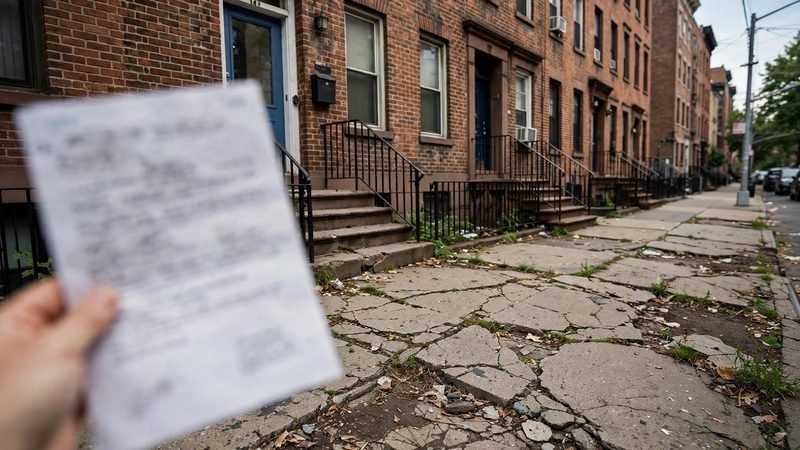
- NYC Sidewalk Repair Costs at a Glance
- How Project Types Compare
- Why Sidewalk Repair Costs More in NYC Than the National Average
- What Determines the Price of Your Sidewalk Repair
- Design and Site Factors That Add to the Cost
- When Repair Costs Less Than Replacement
- What DOT Considers a Defect (and Why It Affects Your Bill)
- What the City Charges If It Repairs Your Sidewalk
- Situations Where You May Pay Less or Nothing
- The Cost of Waiting: Liability
- How to Get an Accurate Sidewalk Repair Quote
- Frequently Asked Questions About NYC Sidewalk Repair Costs
- Get a Clear Price for Your Sidewalk Repair
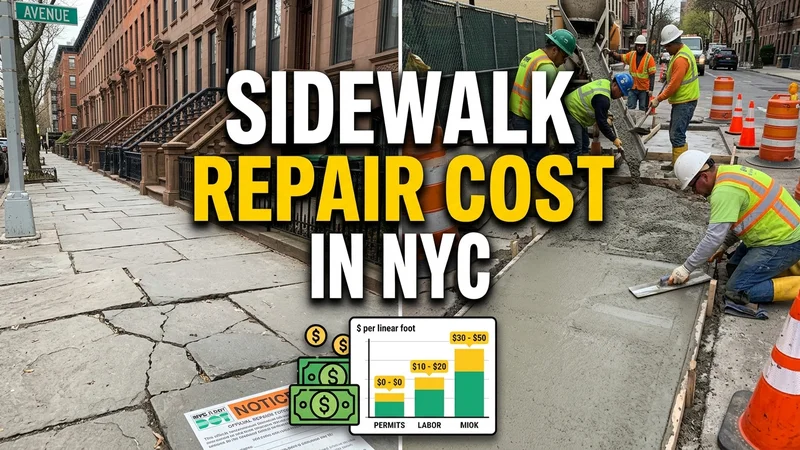
Most private sidewalk repairs in New York City cost roughly $15 to $25 per square foot for full flag replacement, according to local industry estimates. Since a standard NYC sidewalk flag measures 5 by 5 feet, that works out to about $375 to $625 per flag, plus a $70 DOT permit for every 300 linear feet of sidewalk. A small job replacing four flags (about 100 square feet) would land somewhere around $1,500 to $2,500 at those rates, while a full frontage with driveway sections, tree roots, or curb work can run well past $5,000.
Your actual price depends on how many flags DOT marked, whether any sections sit at a driveway or corner, whether street tree roots are involved, and where your property is located. This guide breaks down each of those factors, explains what the City charges if it does the work for you, and covers the situations where you may not have to pay at all.
NYC Sidewalk Repair Costs at a Glance
| Cost item | Typical amount | Type of figure |
|---|---|---|
| DOT Sidewalk Construction Permit | $70 per 300 linear feet of sidewalk, per property | Official DOT fee |
| Full flag replacement | About $15 to $25 per sq ft | Industry estimate |
| One standard 5' x 5' flag | About $375 to $625 | Calculated from the estimate above |
| Driveway and corner quadrant sections | Higher than standard flags (7" slab instead of 4") | Official DOT spec; price varies by contractor |
| Curb repair alongside violation work | DOT may do it at no cost to you | Official DOT policy |
| Flags damaged solely by City tree roots (1 to 3 family homes) | No violation issued; not charged | Official DOT policy |
For context, HomeAdvisor's national data puts sidewalk replacement at roughly $5 to $10 per square foot, with an average repair project around $1,599. NYC prices run noticeably higher, and the reasons are mostly built into City rules.
How Project Types Compare
The table above covers standard NYC flag replacement. For a wider view, here is how common project types compare at national average rates:
| Project Type | Cost per Sq. Ft. | Estimated Total (200 Sq. Ft. Walkway) |
|---|---|---|
| New Poured Concrete (Basic) | $6 - $12 | $1,200 - $2,400 |
| Mid-Range / Decorative | $12 - $17 | $2,400 - $3,400 |
| High-End Custom / Stamped | $17 - $20+ | $3,400 - $4,000+ |
| Full Sidewalk Replacement | $10 - $25 | $2,000 - $5,000 |
| Asphalt Walkway Alternative | $9 - $12 | $1,800 - $2,400 |
Why Sidewalk Repair Costs More in NYC Than the National Average
A national cost guide assumes a simple residential walkway. An NYC public sidewalk has to meet DOT construction standards, pass a City inspection, and get built on a busy street.
The specs alone add material and labor. Under the NYC Highway Rules, sidewalks must be 4 inches of concrete laid on a 6-inch foundation, and driveways and corner quadrants require a 7-inch slab. Flags must be 5 by 5 feet where feasible. That means a contractor usually replaces whole flags instead of patching damaged spots, and every flag needs proper base preparation underneath.
Location matters too. The same rules require pigmented (tinted) concrete in certain high-density commercial districts, including C4-4 through C4-7, C5, and C6, and whenever replacement covers 50% or more of the sidewalk abutting a property in those areas. Tinted concrete and saw-cut joints cost more than standard gray concrete.
Then there's the practical side of NYC work: permits, hauling debris through dense neighborhoods, limited staging and parking, and keeping a safe path open for pedestrians. None of those show up in a national average, but all of them show up in a Manhattan or Brooklyn quote.
What Determines the Price of Your Sidewalk Repair
The number of flags DOT marked
If you received a violation, your scope is already defined. NYC DOT requires every flag marked with a number on the Preliminary Inspection Report (the sketch included with the violation) to be replaced, and all defects corrected. Price per flag drops a little on larger jobs because mobilization, permits, and equipment are spread over more square footage, which is why a one-flag repair often costs more per square foot than a ten-flag job.
Driveways, corners, and thicker slabs
Driveway aprons and corner quadrants need that 7-inch slab, which uses nearly twice the concrete of a standard 4-inch flag. Corner properties also have more frontage, so a violation can cover two street faces instead of one.
Street tree roots
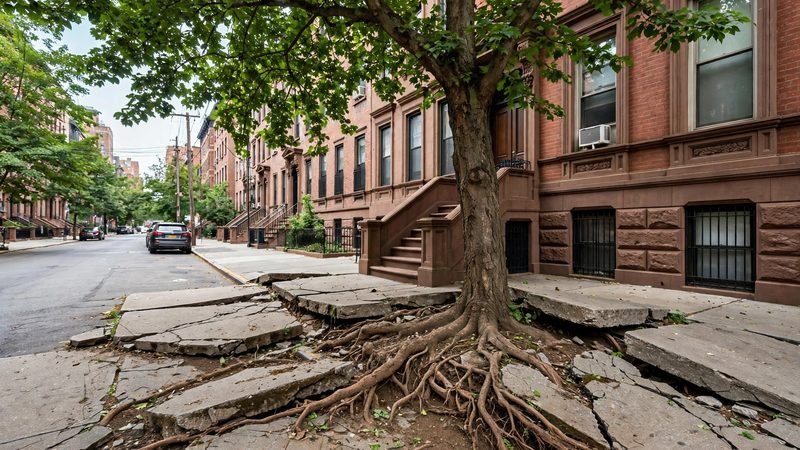
Root damage changes both the cost and the timeline. Work around a City street tree generally requires a Tree Work Permit, and NYC Parks says those permits are typically issued within 45 days. Parks may also require tree-friendly repair methods, such as expanding the tree bed, sloping the new sidewalk over roots with extra base material, or reinforcing slabs with rebar. Each of those adds labor compared with a simple tear-out and pour.
Historic districts
In some historic districts, the Landmarks Preservation Commission regulates sidewalk paving. The LPC sidewalk guidebook explains which districts require an LPC permit and when tinted concrete or historic materials like bluestone come into play. Matching historic materials can raise costs significantly.
Cellar doors, gratings, and other hardware
DOT treats hardware as part of the sidewalk. Cellar doors that flex more than 1 inch when walked on, or hardware that isn't flush within half an inch of the surface, count as defects in the DOT property owner's guide. Resetting or replacing a cellar door is a separate cost from concrete work.
Design and Site Factors That Add to the Cost
Beyond the NYC-specific factors above, these general price factors apply to any concrete sidewalk project:
- Size and Thickness: Standard residential sidewalks are 4 inches thick. Slabs intended to handle heavy vehicle traffic (like driveway crossings) must be 5 to 6 inches thick, which increases material costs by roughly 25% to 50%.
- Design & Finish: A standard gray broom finish is the least expensive. Adding curved edges, custom borders, concrete staining (adding $2 to $5 per sq. ft.), or a stamped finish to mimic stone (adding $3 to $4 per sq. ft.) will push costs toward the higher end.
- Site Preparation: Costs will rise if the contractor needs to clear trees, grade steep slopes ($0.08 to $2.00 per sq. ft.), or install a mandatory 4-inch gravel subgrade base ($10 to $15 per linear foot) to handle drainage and prevent cracking.
- Tree Root Obstructions: If mature tree roots have buckled an existing sidewalk, removing the roots and installing a certified root barrier adds $200 to $800 per root system.
- Permits: If the sidewalk links directly to a public right-of-way or main road, municipal permits usually range from $50 to $300, though strict city codes can sometimes push them higher.
When Repair Costs Less Than Replacement
If your overall sidewalk is structurally sound but has minor damage, repairs are significantly cheaper than pouring new slabs:
- Mudjacking / Polyjacking: Pumping specialized material under a sunken panel to lift it back to level costs $3 to $6 per square foot.
- Trip Hazard Grinding: Shaving down raised concrete joints to eliminate trip hazards averages $6 to $12 per square foot.
- Crack Repair: Sealing minor surface cracks with polyurethane or epoxy injection costs $3 to $8 per linear foot.
Note that for violation work, DOT generally requires full flag replacement rather than patching, as covered in the FAQ below.
What DOT Considers a Defect (and Why It Affects Your Bill)
Knowing the official defect thresholds helps you avoid paying for work you don't need. According to the DOT property owner's guide, the main defects are:
- Trip hazards: a height difference of half an inch or more between adjoining flags, or surface holes at least 1 inch across and half an inch deep
- Full-depth cracks: cracks running joint to joint that are a quarter inch wide or more
- Hardware: fixtures not flush within half an inch of the sidewalk
- Cellar doors: doors that deflect more than 1 inch underfoot
A hairline crack or a slightly weathered surface doesn't automatically mean replacement. If you haven't received a violation and you're repairing proactively, comparing your sidewalk against these thresholds helps you decide which flags actually need work. If you have a violation and believe it was issued in error, DOT allows owners to request a re-inspection within the 75-day window.
What the City Charges If It Repairs Your Sidewalk
Owners have 75 days to repair after receiving a Notice of Sidewalk Violation. If the work doesn't happen, DOT may hire a contractor and the Department of Finance will bill the owner under Section 19-152 of the Administrative Code.
The City's bill isn't a mystery. The DOT guide explains that you can estimate it by multiplying the square footage on your Preliminary Inspection Report by the per-square-foot rate listed in the letter that came with your violation. Driveway areas use the 7-inch concrete rate, and other areas use the 4-inch rate. The final bill can include additional work needed to bring the sidewalk to DOT standards.
A few details in the City process work in the owner's favor:
- Flags marked with an "X" on the report may be replaced free, and you're billed only for the defective flags.
- Flags damaged by trees are non-assessable, meaning you aren't charged for them.
- After DOF bills you, you have 90 days to pay before interest starts, and you can request a payment plan through 311 or a Finance Business Center.
The downside is control and timing. A lien is placed on the property, and you have no say in scheduling. DOT's own 2023 City Council testimony noted that less than one percent of City sidewalk repairs over the previous five construction seasons were made within 90 days of a violation being issued. That means an unrepaired violation can sit on your property record for a long time, which can complicate a sale or refinance.
Some contractor websites claim the City charges two or three times market rates. DOT doesn't publish a citywide comparison, so the most reliable way to compare is to check the rate in your own violation letter against a private quote for the same square footage.
Situations Where You May Pay Less or Nothing
Tree root damage at 1 to 3 family homes. Since 2019, DOT has stopped issuing violations to one-, two-, and three-family properties for sidewalk defects caused entirely by tree roots. If roots are only part of the problem, a violation can still be issued for the other defects.
The Parks Trees & Sidewalks Program. NYC Parks can repair severe root damage next to one-, two-, and three-family (Tax Class 1) homes that are owner-occupied and not used commercially. Funding is limited and sites are prioritized by severity, so it isn't a fast option.
Reimbursement after repairing tree damage yourself. According to NYC Parks, owners who repair a sidewalk they believe was damaged by a City tree may file a claim with the Comptroller's office within 90 days of the repair. Keep your invoice, permit, and before-and-after photos.
Curb repair. The DOT guide states that DOT may repair or replace missing and defective curb at no cost to the owner.
Damage caused by utilities or contractors. If a utility company or contractor damaged your sidewalk, DOT advises documenting the damage and asking that company to make the repair. Claims against City contractors go to the Comptroller within 90 days of the damage.
The Cost of Waiting: Liability
Delaying a repair has a cost that never appears on a quote. Under NYC Administrative Code §7-210, owners of property abutting a sidewalk are generally liable for injuries caused by failing to keep it reasonably safe, including failing to repair or replace defective flags. The law exempts one-, two-, and three-family homes that are at least partly owner-occupied and used only for residential purposes. Commercial buildings, mixed-use properties, and larger multifamily buildings carry that exposure fully, which makes prompt repairs more valuable for those owners.
How to Get an Accurate Sidewalk Repair Quote
Quotes vary widely in NYC, often because contractors are pricing different scopes. Before comparing numbers, make sure each quote answers the same questions:
- Does it cover every numbered flag on your Preliminary Inspection Report?
- Are driveway or corner sections priced at the 7-inch thickness?
- Does it include the DOT permit, debris removal, and disposal?
- If tree roots are involved, does it account for the Parks permit and any required repair method?
- Is pigmented concrete required for your zoning district?
- Will the contractor request the dismissal inspection through 311 after the work is done?
- Can the work start within your 75-day window? A permit doesn't extend the deadline.
A quote that looks cheaper but leaves out the dismissal inspection or a marked flag can cost more later, since the violation stays open until every defect is corrected and inspected.
Frequently Asked Questions About NYC Sidewalk Repair Costs
Is there a fine for a sidewalk violation?
No. According to the DOT property owner's guide, there's no fine or penalty attached to a sidewalk violation itself. The cost comes from the repair, whether you hire a contractor or the City does the work and bills you.
Can I patch a cracked flag instead of replacing it?
For violation repairs, generally no. DOT requires each numbered flag on the inspection report to be replaced, and DOT specifications call for full 5-by-5-foot flags where feasible.
Does a sidewalk permit extend my 75-day deadline?
No. DOT states that a permit doesn't extend the 75-day period, so it's worth getting quotes early.
How much does one sidewalk flag cost to replace in NYC?
Based on industry estimates of $15 to $25 per square foot, a standard 5-by-5-foot flag runs about $375 to $625. Single-flag jobs often cost more per flag because of fixed costs like permits and mobilization.
Can I pay the City's sidewalk bill in installments?
Yes. Owners can request a sidewalk repair payment plan by calling 311 or visiting a Department of Finance Business Center.
Get a Clear Price for Your Sidewalk Repair
If you've received a DOT violation or noticed raised, cracked, or sunken flags in front of your property, start by looking up your property's violation record to see exactly what DOT flagged. Then visit our sidewalk violation removal page for a free estimate: we review your violation, price every marked flag to DOT specifications, handle the permits, and request the dismissal inspection when the work is done.