Understanding Your Sidewalk Lookup Results
A lookup result is a starting point, not a verdict. This page walks through every part of a result card, explains what each field means, and tells you what to do next.
How to read a result card
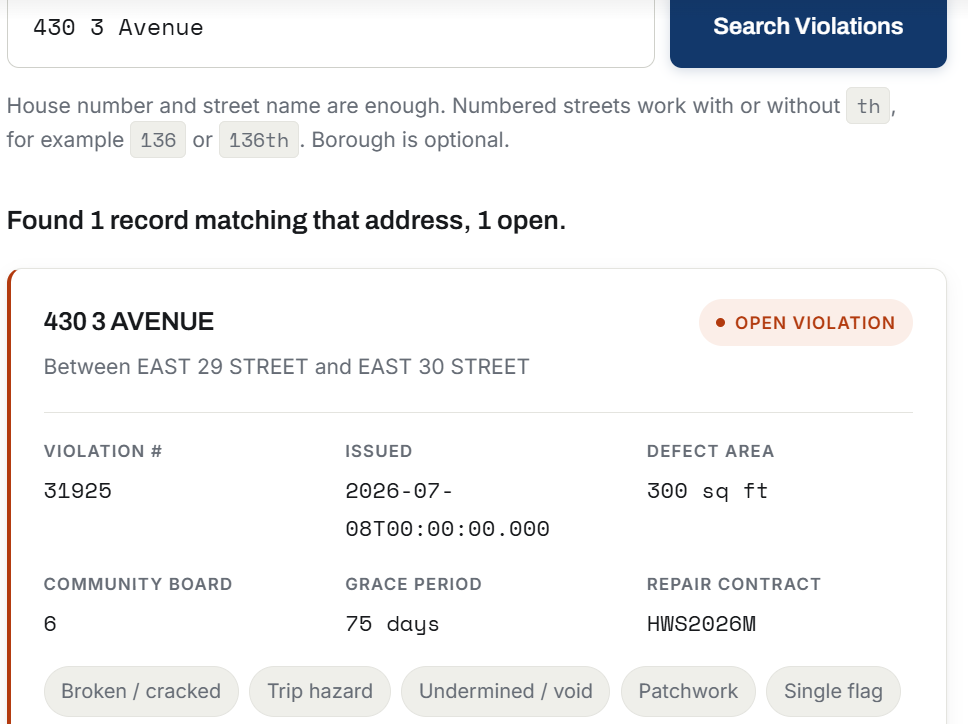
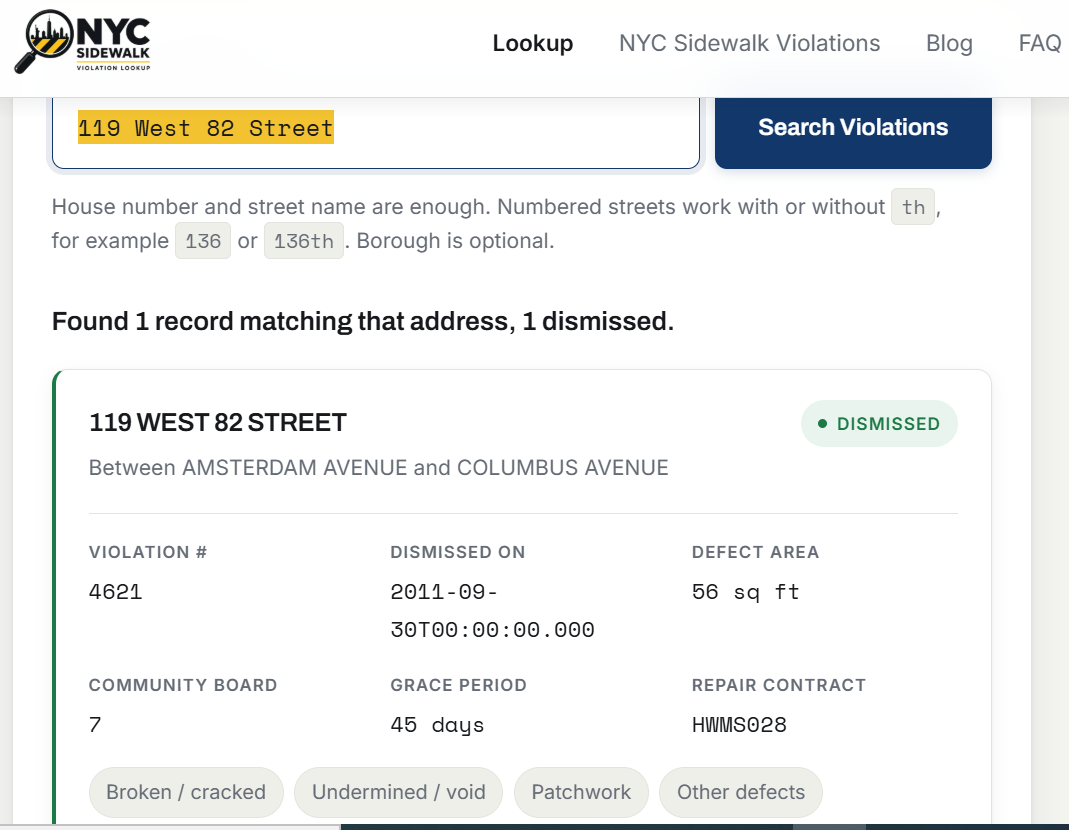
Every result starts with a count line, for example: "Found 1 record matching that address, 1 dismissed." Then each record appears as a card with the same set of fields.
| Field | What it means |
|---|---|
| Status badge | Green Dismissed means the record was closed out. Red Open Violation means the data shows it still open. |
| Violation # | The city's violation number, usually 4 to 6 digits. Have it ready when you call 311. |
| Issued / Dismissed on | The date the violation was issued or dismissed. Dates may show in raw format (for example, 2011-09-30T00:00:00.000) — read just the date part. |
| Defect area | The estimated square footage of defective sidewalk on the inspection report. |
| Community board | The community board district the property sits in. Informational only. |
| Grace period | The compliance window on the record. This varies, real records show 45 days and 75 days. Your actual notice governs, not this field. |
| Repair contract | The city's internal contract code for the repair work, if the city did it. Informational only. |
| Defect pills | The defect types found, shown as tags (see below). |
| Cross streets | The block where the property sits, shown as "Between X and Y." Useful for confirming the record matches your property. |
What "Open Violation" means
The red badge means the published data has a violation record for the address with nothing showing it dismissed. Treat it as real until proven otherwise.
What to do next:
- Note the violation number and the issued date.
- Request the official status through 311. Only DOT can confirm what the current legal record says.
- If you are the owner, the repair clock runs from when the notice was received, not from the issued date shown here. Read our complete guide to NYC sidewalk violations for what happens next.
What not to assume: this dataset is not the County Clerk's legal record. Before a closing or refinance, confirm through 311 or the Clerk.
What "Dismissed" means
The green badge means the record was closed, an inspector confirmed the repair, or the city did the work and closed the file. Dismissed records stay visible in the data; dismissal closes the violation, it does not erase the record. A dismissed violation should not block a sale or refinance on its own.
What to do next:
- If a title search still flags it, request a status confirmation through 311. Old records can linger in third-party datasets after the city clears them.
- Keep your dismissal paperwork (permit number, inspection confirmation) with the property records.
What the defect pills mean
The tags on a result card map to the defect list in § 19-152 of the Administrative Code:
| Pill | What it refers to |
|---|---|
| Broken / cracked | Cracked flag — cracked badly enough that pieces may loosen |
| Trip hazard | A raised edge of half an inch or more between flags |
| Undermined / void | A visible void beneath the flag, or a flag that rocks |
| Patchwork | Thin or partial repairs instead of full-depth replacement — itself a citable defect |
| Single flag | A single defective flag cited on its own |
| Other defects | Anything else on the inspection report — check the full record |
If the pills don't match what you see on your sidewalk, you can request a re-inspection within 75 days of receiving the notice.
What a result doesn't tell you
No record is not proof of no violation. Datasets update on the city's schedule. A recent notice may not appear yet, the address may be recorded differently in city systems, and old records can be purged from published data while still existing at the County Clerk.
Dates are raw. Timestamps like 2026-07-08T00:00:00.000 are unformatted database values. Read the date, ignore the rest.
The grace period field varies. Real records show different values. The compliance deadline that matters is the one on your official notice.
Multiple records are normal. DOT's rule is that the newest violation supersedes all previous notices, so older records in the data are usually superseded, not separate obligations. Work from the most recent record.
How to confirm any result
For anything that affects money or legal exposure — buying, selling, refinancing, disputing a bill — confirm through an authoritative route:
- 311: request the status or a copy of a sidewalk violation. DOT responds to the request. Have the violation number ready.
- County Clerk: holds the filed copy of the notice. This is the record a title search reads.
A note on data freshness
City datasets update on the city's schedule, which can lag behind DOT's internal records by days or weeks. A lookup reflects the data as last published. When timing matters, go straight to 311.