Based on NYC Department of Sanitation (DSNY) guidance and NYC Administrative Code §7-210
Short answer: The person in charge of the property next to the sidewalk must clear it. That is the owner, landlord, tenant, occupant or anyone else who has charge of the lot or building. The NYC Department of Sanitation (DSNY) plows the streets. You clear the public sidewalk.
Quick Facts
| Question | Answer |
|---|---|
| Who clears the sidewalk? | Every owner, lessee, tenant, occupant or other person having charge of any lot or building |
| Which sidewalks? | Those in front of, on the side of, and in back of the property |
| Who plows the street? | DSNY |
| Recommended path width | At least four feet, where possible |
| Fire hydrant in front of your property? | Keep it clear of snow and ice |
| Fines (per DSNY guide) | $100 to $150, then $150 to $350, then $250 to $350 |
| How to report an uncleared sidewalk | NYC 311 |
Who Is Legally Responsible
DSNY quotes the NYC Administrative Code on this point. The duty applies to "every owner, lessee, tenant, occupant or other person having charge of any lot or building." The list is broad on purpose, so the duty does not depend only on who is named on the deed.
- Property owners: This includes homeowners, landlords, co-op and condo boards, and commercial owners.
- Tenants and occupants: Anyone who has charge of a building can be responsible, such as a store tenant. If you rent, read your lease to see who is expected to handle snow.
- Property managers: A manager running a building on an owner's behalf is "in charge," so building staff should have a snow plan.
- Private streets: DSNY advises residents on a private street to get together with their Homeowner Association (HOA) and make sure there is a plan for snow removal.
Which Sidewalks You Must Clear
The code covers sidewalks adjacent to your property, meaning in front of, on the side of, and in back of it. A corner lot therefore has more sidewalk to clear than a mid-block building.
Does the Small-Homeowner Liability Exemption Apply to Snow?
This confuses many people. NYC Administrative Code §7-210 makes most abutting owners liable for injuries caused by a failure to maintain the sidewalk, and it names failure to remove snow and ice as part of that failure. Owner-occupied one-, two- or three-family homes used exclusively for residential purposes are exempt from that injury liability.
That exemption concerns lawsuits over injuries. DSNY's snow rules say every owner, lessee, tenant or occupant must clear snow and ice. Nothing in DSNY's guide excludes small homes. A homeowner who is exempt from injury liability can still be fined for an uncleared sidewalk. Read more about who is responsible for NYC sidewalk repairs.
How Long You Have to Clear the Snow
The clock depends on when the snow stops falling, not when it starts. DSNY sets three time windows:
| Snow stops falling between | You must clear |
|---|---|
| 7:00 a.m. and 4:49 p.m. | Within four hours |
| 5:00 p.m. and 8:59 p.m. | Within fourteen hours |
| 9:00 p.m. and 6:59 a.m. | By 11:00 a.m. the next day |
DSNY's guide lists the first window as ending at 4:49 p.m. and the second as starting at 5:00 p.m. A 2020 fact sheet from the City describes the first window as ending before 5:00 p.m. If your storm ends right around that line, clear the sidewalk as early as you can instead of cutting it close.
Worked Examples
- Snow stops at 2:00 p.m. You must finish by 6:00 p.m.
- Snow stops at 7:00 p.m. You have fourteen hours, so you must finish by 9:00 a.m. the next morning. This is DSNY's own example.
- Snow stops at 11:00 p.m. You must finish by 11:00 a.m. the next day.
- Snow stops at 3:00 a.m. You must finish by 11:00 a.m. the same day.
How to Clear the Sidewalk Correctly
DSNY gives specific instructions on how to clear the sidewalk, not just when.
1. Clear Along the Whole Frontage
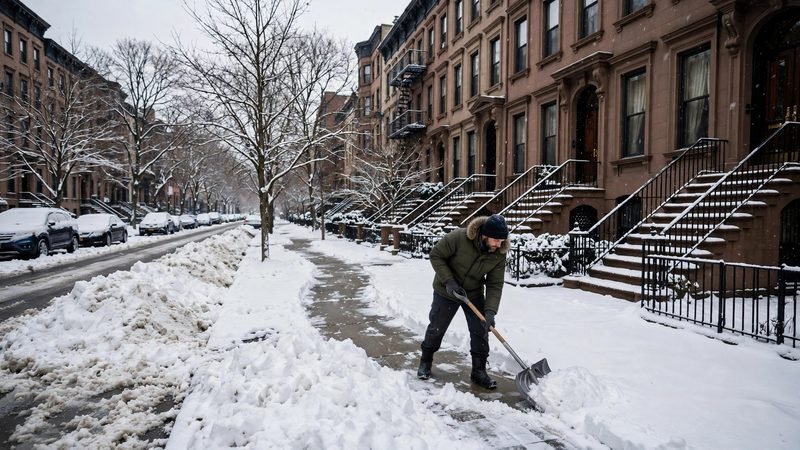
Remove snow along the sidewalk adjacent to your property. Clear to the surface, not just a narrow trail.
2. Aim for a Four-Foot Path
Where possible, clear a path at least four feet wide. DSNY explains the reason: it helps people in wheelchairs, people with children in strollers, students going to school, and people using mobility-assistance devices.
3. Put the Snow in the Right Place
- Do not push snow from the sidewalk into the street.
- Do not cover crosswalks with snow.
- Do move it to your front yard, behind the stoop line, or onto the grassy curb strip if one exists.
4. Handle Corner Properties With Extra Care
Corner property owners should clear a path to the crosswalk, including any pedestrian ramps. If melting snow creates a puddle, disperse the water away from the crosswalk.
5. Keep the Fire Hydrant Accessible
If there is a fire hydrant in front of your property, clear the snow from around it. DSNY says the person having charge of the adjoining property is responsible for keeping the hydrant clear of snow, ice and other debris so it is accessible in a fire emergency.
6. Think About Catch Basins
There is no specific requirement to clear snow around catch basins. They provide drainage when snow and ice begin to melt, though. Clearing them and cutting a channel toward them helps prevent flooding. Neighbors often handle this together.
7. Clear the Plow Ridge at Your Driveway
Plows leave a ridge of snow at the end of many driveways. DSNY must plow to create a passable driving lane, so the ridge is an unavoidable side effect, especially in heavier storms. Residents are responsible for clearing it. DSNY suggests clearing driveways after street clearing is finished, so you do not dig out twice.
Never throw that snow into the street. If Sanitation personnel observe snow placed in the street, you could receive a Notice of Violation with a $100 fine.
What About Bus Stops?
The 2020 City fact sheet says property owners are not required to clear bus stops. DSNY suggests that owners clear a path from the sidewalk to the curb at the bus stop. Bus shelters are handled separately, so if you are asked about shelter clearing, check with DSNY.
Penalties for Not Clearing the Sidewalk
DSNY's guide lists these fines for homeowners, property managers, businesses and others who do not comply:
| Offense | Fine |
|---|---|
| First | $100 to $150 |
| Second | $150 to $350 |
| Third and subsequent | $250 to $350 |
Two cautions apply. The DSNY guide supplied for this article is dated 11/25/2014, and news coverage of recent storms has quoted slightly different amounts, for example $100, $150 and $250. Confirm current figures with DSNY or NYC 311 before relying on any number. Also remember that a fine is not the biggest risk. If someone slips on snow or ice you failed to clear, a non-exempt owner may face an injury claim under §7-210.
How to Report an Uncleared Sidewalk
Residents can file a "Failure to Clean Ice/Snow from sidewalk" request with NYC 311, by phone or at nyc.gov/311. DSNY asks you to do three things so the report can be acted on. Learn how NYC sidewalk inspections work once a report is filed.
- Confirm it is a public sidewalk. Stoops and internal pathways do not count.
- Give a specific address.
- Wait out the clearing window. The required time period must have passed since the snow stopped.
Preparing Before the Storm
DSNY's guide offers practical advice:
- Get a good snow shovel and ice melt or traction material before the season starts.
- If you live on a private street, agree on a plan with your HOA.
- Pace yourself, because shoveling can be physically intensive and strenuous. After heavy snowfall, consider hiring a service or a person.
- If you can, look in on neighbors who are elderly, disabled or homebound.
Landlords and managers should decide in advance who is shoveling, who is the backup, and how the work will be recorded.
Frequently Asked Questions
Is the City or the property owner responsible for shoveling the sidewalk in NYC? The person in charge of the adjacent property is. DSNY handles streets, not private frontage sidewalks.
Do renters have to shovel? They can. The code names tenants and occupants alongside owners, and a lease may assign the task. If a lease is silent, the owner is still in the responsible group.
How long do I have to shovel after it stops snowing? Four hours, fourteen hours, or by 11:00 a.m. the next day, depending on the time the snow stops.
Can I push snow into the street? No. DSNY says not to, and a $100 Notice of Violation is possible if it is observed.
Do I have to clear the fire hydrant? Yes, if one is in front of your property.
How wide should my path be? At least four feet where possible.
Who clears the snow ridge left by the plow at my driveway? You do.
What is the fine? DSNY's guide lists $100 to $150 for a first offense and higher for repeats. Confirm current amounts.
How do I report a neighbor's or a building's uncleared sidewalk? Use NYC 311 and follow the three reporting rules above.
The Bottom Line
The responsible party is whoever has charge of the building next to the sidewalk, and the duty reaches the front, side and back. Watch the time the snow stops, clear a path of at least four feet, keep crosswalks, ramps and hydrants open, and put the snow where it will not block anyone else.